Finding The Lost Fishermen: Cinematic Adaptation as a Safeguard for Ghana’s Ailing Folk Operatic Tradition
Moses Nii-Dortey
Abstract
This paper interrogates the meanings, praxis and theoretical implication(s) of cinematic adaptation as a safeguard for Ghana’s ailing operatic arts using The Lost Fishermen folk opera as a case. It explores the extent to which the underlying objective to safeguard, the peculiarity of the operatic art as one genre that privileges integration of music with drama, as well as the change of medium from theatre to cinema, foreground (in)fidelity as a key contextual issue in the determination of the project’s success. Saka Acquaye (1923–2007) pioneered the art form in the decolonial spirit of Ghana’s political independence from colonial rule in 1957 and its immediate aftermath. Some 30 years after it premiered, however, the once highly popular genre was already in danger of extinction. Kwame Crenstil’s piloted cinematic adaptation in June 2023 is part of the search for a viable safeguard for the endangered genre. The paper argues that cinematic adaptation for the purpose of safeguarding ought to be conceptualised in terms of composite audio-visual documentation for the ease of accessibility and viewing, and for achieving socio-cultural relevance in contemporary terms. Since adaptation is inherently subject to the vagaries of representation, notions of fidelity on which the success of safeguarding hangs, cannot mean exact reproduction due to the change of medium but in terms of the degree to which the resultant story resembles the referent.
Introduction
From the 8–10 June 2023, Ghana’s first ever attempted film opera—a cinematic adaptation of an operatic art (music theatre), was successfully shot at the serene Keta beach, southeast of Ghana. The specific artwork was Saka Acquaye’s (1923– 2007) most popular folk opera—The Lost Fishermen, which he premiered in 1965 at the Opera House in Accra central, Ghana.1 Saka Acquaye was the most prolific Ghanaian operettist who was recognised by UNESCO, in February 2007, as one of two Living Human Treasures of Ghana, for his extraordinary creativity in both the performing and plastic arts, including folk opera, music, painting and sculpture.2 The 25-minute film opera was undertaken by Kwame Crenstil — a film producer and a master's student at the Institute of African Studies, University of Ghana, Legon. The project, which was intended as a teaser to raise funds for the larger The Lost Fishermen film project, was supported financially by the Mapping Africa’s Musical Identities Research project headquartered at the University of Cape Town and funded by the Andrew Mellon 30th Anniversary Early Career Scholar Program.3 The first public showing of the short film was at the “African Operatic Voice Conference” at the Bern University, Switzerland, from the 8–10 September 2023. Feedback from the conference attendees praised the high-definition video and sound qualities, as well as the rendition of the entire film in Saka Acquaye’s indigenous Ga language with running interpretation in English.
Adaptation of operas to cinema is not new to Africa, particularly for countries such as South Africa, Senegal, and Nigeria with long histories of the art form. Some of the more recent film operas include U-Carmen eKhayelitsha which van der Hoven and Maasdorp (2020) described as one of the first and most successful post-apartheid film operas shot in southern Africa. Also, Unogumbe and Breathe–Umphefumlo, both film adaptations by the South African theatre company Isango Ensemble of Western Classics of Music Theatre in 2013 and 2015 respectively, are film adaptations of Benjamin Britten’s Noye’s Fludde (1957) and Giacomo Puccini's La Bohème (1896). Outside of South Africa, Ousmane Sembene’s Borom Sarret and La Noir De may have led the way earlier in 1963 and 1966 respectively. But, in terms of reach, the Nigerian film industry qualifies for special mention with adaptations of the famous Yoruba Travelling Theatre (alarinjo) and other plays for the screen.4 Key examples include Duro Ladipo’s popular Oba Koso (1960) adapted for television, and Ola Balogun’s Ajani Ogun (1976) which emerged as one of Nigeria’s most successful folk operas adapted to film.5
For Ghana’s bourgeoning film industry however, Crenstil’s adaptation of a folk opera is a marked departure from the usual film industry practice where literary works such as novels, short stories, and myths are mostly prioritised.6 Occasionally, films have also been adapted and the most recent film-to-film adaptation in Ghana is Kofas Media and Miracle Wave International’s US $150,000 budget movie, John & John – The Tale of the Greedy Bastards – an adaptation of the multiple award-winning South African director Tim Greene’s 2011 film, Skeem. It was successfully premiered at the West Hills Mall and Accra Mall’s Silverbird Cinemas in 2017. The uniqueness of Crenstil’s project is also based on its primary objective to explore the cost- and technology-intensive domain of cinematic adaptation as a potential safeguard for Ghana’s ailing operatic tradition. The reference to Ghana’s operatic tradition is in acknowledgement of the existence of other operatic forms, such as the church cantata and the popular concert party travelling theatre, both of which predated Saka Acquaye’s folk operas.7 Both Saka Acquaye and Walter Blege, who also wrote a single folk opera titled Kristo (1982), acknowledged the immense influence that Cantata, for example, had on their works.
By the mid-1990s, all ten of Saka Acquaye’s folk operas, as well as their popular concert party precursors, had become threatened with extinction based on Catherine Grant’s five-year Framework for Measuring Music Vitality and Endangerment (MVEF).8 Unfortunately, the mainly ethnographic initiatives by the author to research, document and revive Saka Acquaye’s folk operas in the last two decades, have resulted in saving only one (The Lost Fishermen) conclusively out of the ten through written documentation. The Lost Fishermen has since been performed, rather unsuccessfully, twice on stage in 2007 and 2011 in Accra, through a collaboration with an Accra-based amateur drama ensemble called the Accra Kushite Company. Even though the production team’s marketing strategy may be faulted, there is no doubt that the many years of inter-generational break in transmission, the seeming obsoleteness of the mainly religious and nationalistic themes of the operas, as well as the failure to keep pace with advances in related technologies are more to blame for the unsuccessful relaunch of Saka Acquaye’s folk operas.9
So, what is cinematic adaptation, and how may the technology-intensive domain remedy the causal factors of folk opera endangerment as well as serve as a safeguard against future threats? What are the core theoretical and operational implications of adapting an operatic art to cinema with the aim to safeguard it? To what degree does the defining feature of the operatic arts which, unlike cinema, privileges the integration of music with drama impact the resultant film opera’s fidelity to the original work? This paper explores the adaptation dynamics of folk opera to film using The Lost Fishermen piloted by Kwame Crenstil in 2023. The argument is that the solution to Ghana’s folk opera endangerment lies in a relatively superior documentation and production regime, preferably one that employs audio-visual technology to guarantee ease of accessibility, user/viewer-friendliness as well as offers a platform for transcending the existing intergenerational gap. The paper wades into the raging debate over the relevance of “fidelity” in film adaptations arguing in favour of a reasonable measure of fidelity to qualify the filmic product as a safeguard and to warrant the retention of the original’s title.
Ghanaian folk opera and decoloniality
As with all the operatic arts, Ghanaian folk opera is an integrated musical art. Saka Acquaye describes folk operas as “composed of airs, recitatives and pieces performed by choruses with orchestra, and which makes use of scenery, acting and a blend of poetry and dance.”10 The entirety of songs, libretti, costume, and other performance materials are deliberately drawn from indigenous African sources. However, the mention of orchestra in the definition needs to be understood very broadly as any instrumental ensemble since, by practice, Acquaye employed different instrumental accompaniments for several of his works ranging from a drum ensemble for The Lost Fishermen, a marching band for Obadzen, and a western-styled orchestra for Hintinhintin.11 It has been argued that because the operatic arts exemplify the integrated ethos of the African musical arts, it makes them “…the most accessible vehicle even for the most distinctive African themes from antiquity and mythology,” a natural medium for contemporary African artists to articulate the needs, character and aspirations of black people, and resistance in decolonial contexts.12 Saka Acquaye, for example, is quoted to have remarked about his motivation for folk operas thus: “I have always thought of the best way to reach the majority of our people. It occurred to me that music, dance and drama were popular and can point to problems of society and contribute to its development using opera.”13 The problems Acquaye referred to in this quote included a growing obsession with western culture by the educated elite in particular because of Ghana’s century-long encounter with colonialism (1874 to 1957). There was also the internal threat to the new nation state posed by disruptive ethnic and sectarian interests following Ghana’s political independence from colonial rule.14 These challenges were not peculiar to Ghana. Other African countries such as Tanzania, Nigeria, and Rwanda, just to name a few, went through similar post-colonial sectarian tensions—some resulting in destabilising catastrophes.15 Acquaye saw in folk opera’s integrative ethos an opportunity to represent a united post-colonial nation-state on the stage as well as valorise the African personality and cultural values through the arts, as espoused by Ghanaian President Kwame Nkrumah.16 Acquaye’s operas were thus inspired by a spirit of nationalism and decoloniality; hence, folk opera occupies a special place in Ghana’s cultural history and nation-building efforts.
The Lost Fishermen story portrays what Kofi Saah and Kofi Baku describe as local peculiarities of Ghanaian nationalism because of the absence of a national language.17 It was based on a Ga (Acquaye’s native ethnic group) legend which tabooed sea fishing on Tuesdays. Set in a nineteenth-century coastal Accra village, the plot is built around the arch protagonist, Kotey, who lures an entire fishing crew (including his father the village chief) to violate the sacred taboo. Acquaye used The Lost Fishermen folk opera to criticise the growing disregard for indigenous culture by the educated elite. Below is a synopsis of Acquaye’s original The Lost Fishermen:
Ten fishermen, led by their village chief (Ataa Amasa) and his two princes (Kotey and Ashie), desecrate the taboo of the sea by embarking on a fishing venture on a Tuesday. Tuesday is the day sea fishing is prohibited by the gods in the Ga area. The fishermen’s excuse is that Kotey deceived them to think that the day is a Wednesday instead. As a direct consequence, the fishermen are caught up in a violent storm believed to be a direct punishment from the sea gods for their irreverent act, and they go missing on the high seas for weeks. With no help in sight, they painfully sacrifice the chief’s younger and beloved son through Kotey’s machinations, to placate the sea gods. Paradoxically, the sea gods accept the sacrifice because of the innocence of the victim’s blood and, as a result, direct the remaining nine-member crew to safety on a strange island believed to be located at the centre of the world (where the two zero-degree lines meet, off the coast of Ghana). The nine fishermen meet ten women who had been stranded earlier on the strange island and the romantic relationships that ensue among some of them breed very noxious rivalries and intrigues which result in two more deaths caused by the same villain, Kotey. The remaining fishermen and women manage to find their way back to their homeland in Accra leaving Kotey, the murderer, to die in loneliness on the strange island (Refer to Figure 1).
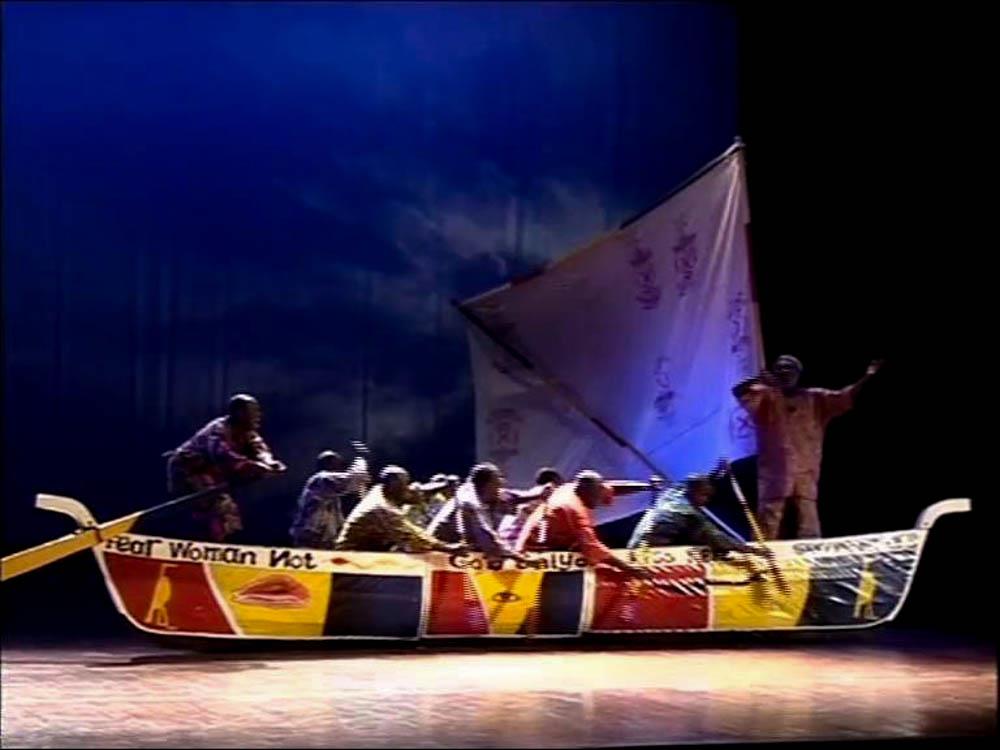
Figure 1. Screenshot from The Lost Fishermen folk opera 2007 theatre version.
Act I by the Accra Kushite Company showing nine actors/fishermen simulating canoe paddling on stage.18
Owing to their nationalistic and decolonial foci, Acquaye’s folk operas benefitted immensely from the patronage of the Nkrumah-led government of the time. Consequently, the violent overthrow of that regime in 1966 and its socio-cultural fallout impacted not only the people who supported the regime, but also some art forms and the institutions that were created to support them.19 In Ghana, Acquaye’s folk operas were not the only arts that bore the brunt of the ideological/ political backlash after the coup that toppled Nkrumah’s government. Nkrumah’s sculptures were literally pulled down and damaged, and intangible art forms such as songs composed to celebrate Nkrumah and his political projects fizzled out of public prominence soon after his overthrow.20 By 2002, when I got the opportunity to meet Acquaye at his home, the art form has been dormant for close to two decades.
Another causal factor is the rather incomplete documentation approach Saka Acquaye adopted for his operatic works. Apart from the libretti, occasional hand-written notes detailing song titles, order of song presentation and stage directing cues, the playwright failed to document the songs and their instrumental accompaniments as well as he did for the stories. He relied essentially on his memory and those of his assistants who took part in the initial rehearsals and stage performances. The idea, it appears, was to exploit the combined creative and performance strengths of both orality and textuality to enable him to get his artworks onto the stage in a relatively quicker time. Thus, apart from a 1977 VHS recording of The Lost Fishermen at the 2nd Festival of Arts and Culture in Legos, Nigeria, the rest of the operas were literally endangered because of the unavailability of the full documents. The written plays are often not hard to find, but not the music. Crenstil’s motivation for choosing The Lost Fishermen for his adaptation project was based largely on the availability of the composite script, both story and music, following the successful recovery through research and documentation.
Adaptation, the Fidelity Challenge and The Lost Fishermen
Cinematic adaptation presents as both “product” and “process,” and it involves the transfer of a work of art to feature film.21 The growing prominence of adaptations in the global film industry, is attributable to film’s transition from a mere spectacular art to a story-driven narrative format, as well as film makers’ discovery that “telling a good story in moving pictures require a good story.”22 The adaptation processes often raise two basic issues: first is the change of medium with its attendant challenge of genre compatibility. In reaction to the compatibility challenge, some essentialists have suggested that adaptation can never be done successfully because it involves transposing the “essence” of one medium to a different one. The essentialists’ argument seems particularly valid regarding transferences that involve single track media, such as novels and short stories to cinema which is a multitrack medium.23 By this same logic, it can also be argued that adapting multi-track genres like theatre, opera and film to film presents a relatively more technically feasible adaptation platform as they share several features in common with cinema—theatrical performances, music, sound effect, and moving images. While the essentialist argument may be technically valid, adaptation successes (of both single and multi-track genres) in the global film industry since the 1950s serve as sufficient proof that the essentialists’ view on adaptation is theoretical at best.24
The second issue that adaptation raises is about fidelity, and that is whether fidelity of the filmic product to the original medium is a necessary requirement for judging the adaptation process to be successful. “By ‘fidelity’ in cinematic adaptation is meant the critical issue of the degree to which the film captures the significant aspects of the original work.”25 In this project, it is also about the extent to which the resultant film opera represents the original story and music because it is an operatic art. It might be necessary to revisit the debate over the fidelity issue—and that is whether it should be a necessary theoretical criterion for evaluating the success of film adaptations. In his paper “On the Appreciation of Cinematic Adaptations,” Paisley Livingston offers a strong defence of fidelity as a criterion by defining a successful cinematic adaptation in a manner that prioritises fidelity while making room for creative innovations because, as he claims, adaptations are not mere copies or reproductions. He asserts:
I propose that a cinematic adaptation is a film intentionally and overtly based on at least one specific anterior work … For a work to be an adaptation, many of the distinguishing and characteristic features of this source, such as the title, setting, main characters, and central elements of the plot, must be expressly adopted and imitated in the new work. As adaptations are distinct from mere copies or reproductions, they must also be intentionally made to diverge from the source in crucial respects.26
However, Robert Stam and Linda Hutcheon both argue against making fidelity a necessary methodological requirement in adaptations involving works of literature, art, film, or other media on the basis that adaptations are automatically different and original due to the change of medium.27 Hutcheon not only affirms the film maker’s creative ownership of the adapted material but also asserts that the “one way to think about unsuccessful adaptations is not in terms of infidelity to a prior text, but in terms of a lack of the creativity and skill to make the text one's own and thus autonomous.”28
Even though these opposing views are valid adaptation perspectives, my own opinion is that they tend to treat the processes involved in cinematic adaptation as an individualistic creative venture involving the sole prerogative of the film maker and denying the primary and tacit creative agency of the original author as a key player. Stam and Hutcheon seem to deny the adaptation process as only a secondary creative intervention that needs to bear the thematic imprint of the original to keep the referent’s label.29 In my view, film adaptations ought to be seen as a confluence of primary and secondary creative inputs — an interactively engaging creative process between original and secondary creative persons. The adaptation process therefore constitutes a “dialogic” transfer of a work of art or story, either in whole or in part, to a feature film. Two scholarly sources that affirm this perspective on adaptation include Robert Stam’s description of the process as “an ongoing intertextual dialogical process.”30 Even though, Stam takes a strong stance against the necessity of fidelity in cinematic adaptations, his framing of the processes as “dialogic” succinctly captures adaptation’s creative essence. Even more explicit is the explanation on the Chapman University website on cultural history titled “A Critical History of Film Adaptation” which states: “when filmmakers interpret the ‘reality’ found in a work of literature, the final vision reflects not only the ideas of the original author, but also the vision of the filmmakers.”31
I want to suggest that a central theoretical issue in the cinematic adaptation of a musical theatre for safeguarding purposes is fidelity to the original work contrary to what scholars like James Harold and Robert Stam have argued forcefully. In other words, if the safeguarding variable is taken out of the equation, then the fidelity argument may well be a non-issue as the final product’s success would depend largely on the film makers’ creative idiosyncrasies and the audience’s reception of it.32 Perhaps a way out of the debate is to accept that there can be different models of cinematic adaptation—at least two models based not only on the nature of the genres involved but also on the motivation for the adaptation initiative. For example, it is possible to identify one model in which the adaptation emanates solely from a film maker’s desire to create a new cinematic version of an older work that excites him/her for various reasons. This fits into Stam’s affection model—a kind of loose adaptation in which the film maker exercises a great deal of discretionary choices along the various facets of the creative process.33 In such a scenario, the basis for attributing success or failure hinges largely on the understanding that the adaptation is a new and autonomous creative work—one to which the original work’s importance is limited to the provision of the initial inspiration. Such adaptations should be celebrated (particularly if successful based on the audience’s acceptance of it) on the basis that they advance the frontiers of creativity by opening more innovative possibilities about the original story than was previously known.
Similarly, another adaptation model is activated when the main purpose for the adaptation is to safeguard against endangerment, or to pull an existing work from the brink of extinction. This often occurs where the work in question is not properly documented—i.e. where the work is an oral art in its entirety, or straddles both orality and textuality as is the case with Saka Acquaye’s folk operas.34 The composer’s approach was to exploit the combined creative and performance strengths of both orality and textuality for a relatively quicker turnaround time. While the playwright duly scripted his stories, he failed to do the same for the music. They existed essentially in the playwright’s memory and, perhaps, those of his assistants. Hence, on occasions when some performances were recorded on audio and/or visual tapes (which were not very common in the 1970s and 1980s in Ghana), such recordings have served as the only form of composite documentation. On the contrary, where no audio and/or visual recordings have been found, the composer’s absence (and his immediate assistants too) has literally plunged the works into a state of disuse and ultimate extinction.35 For this scenario alone, it makes a lot of sense to pursue fidelity as an end: one that respects the boundless frontiers of individual creativity exercised within the remit of fidelity to story, themes, songs and the moods they elicit to merit the retention of the original work’s tittle. Such an objective will not preclude intentional and mandatory innovations in addition to changes occasioned by medium change. Because medium-change inspired innovations in film adaptations are mainly technology-driven, they present as mandatory creative undertakings that need to be managed to achieve a reasonable degree of fidelity. This adaptation model, in my view, is the type that best describes Crenstil’s film opera project. Below is a synopsis of Crenstil’s short film version of The Lost Fishermen story.
This is a gripping short cinematic adaptation of the acclaimed folk opera by Saka Aquaye which was first staged in 1965. The legend of The Lost Fishermen is set in a nineteenth-century fishing community in Accra, Ghana. Kotey, the oldest son of a chief fisherman, Ataa Amasa, finds himself torn between tradition and personal conviction. Against the warnings of his father and the strict fishing rules of the village, Kotey takes charge and leads a group of defiant fishermen to sea on a tabooed day. Ashie, the youngest son of Ataa Amasa seeking to prove himself to his older brother Kotey, unexpectedly joins the expedition. The gods punished them for their defiance, and they get lost at sea. To find their way home, the gods must be appeased. A sacrifice must be made. The clock is ticking for a decision to save the fishermen so they can return home. The Lost Fishermen explores themes of tradition, sacrifice, family bonds, and the struggle to reconcile personal ambition with societal expectations. Through stunning visuals, captivating musical compositions and poignant performances, this short musical promises to captivate audiences with its emotional depth and gripping narrative.36
Cinematic Adaptation, Medium Change, Innovations and the Fidelity Issue.
The extensive use of media technology for the film opera translates into major technical decisions about the screen format, what film stock to use, decisions about cameras, lenses, drone video recordings on the high seas, lighting, as well as combining daytime and nighttime scenes. Additionally, studio-sound recordings and editing, which ultimately delayed the premiering of the film opera for several months, underscore the extent of innovations occasioned mainly by the medium change, the remarkable difference between the live, processual and ephemeral theatre format of the original, and the cinematic production processes structured in the form of pre-production, production and post-production.37 The creative innovations provide a necessary basis for appraising the success of the adaptation as a safeguard.
The striking issue in this paper is how to confirm the extent to which the cinematic product safeguards the original The Lost Fishermen story despite the extensive innovations described below, and how the adaptation processes may serve as a pointer to salvaging the remaining endangered operas. These questions are relevant in the sense that even though the audiovisual recordings of the original theatre version alone can serve as a good enough protection against extinction, it is ultimately the extent to which the film adaptation reflects the original story and its realities that can guarantee its acceptability as a safeguard. My reference to the idea of acceptability is from the viewpoint of a researcher who has been working on this opera for over two decades. What is new therefore is in the technical requirements and processes leading to the film adaptation. I wish to assert that adaptation needs fidelity, and that if fidelity were to be taken out of the adaptation matrix, then most adaptation works could be guilty of various degrees of plagiarism. However, since adaptation is essentially representation that “can never be an exact reproduction of reality”, the fidelity question ought to be understood in terms of “to what extent …” the adaptation retains some of the details of the referent story.38 André Bazin describes this feature of representation as “the illusion of reality.”39
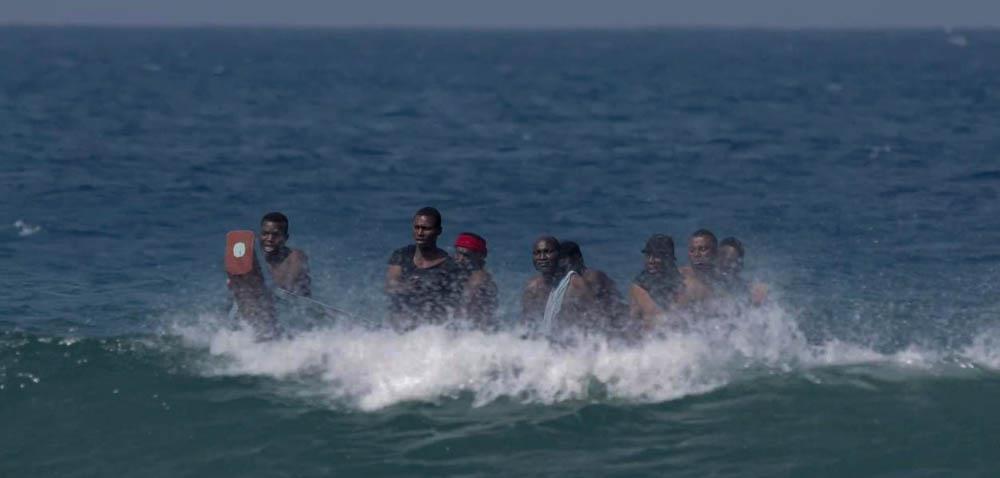
For example, in line with the cinematic ethos of realism, The Lost Fishermen was shot at a beach location in Keta in the southeastern tip of the Volta Region in Ghana, for three days. The place is about 180 kilometres away from the national theatre in Accra where the two previous live presentations were staged. The movement to a location by the crew, use of an actual dugout canoe on the sea instead of a makeshift one for the stage, a fishing net, as well as the actual movements to and from the high seas, combine to bring The Lost Fishermen story and its intended moods closer to reality than Acquaye managed to achieve through the theatre medium. Thus, the cinematic ethos of shooting from location, even though it deviates from the original theatre plot/script, enhances fidelity to the adapted story (see Figure 2).
Figure 2. Screenshot from Kwame Crenstil's adaptation of The Lost Fishermen (2023) showing actors/fishermen in the throes of violent sea waves in situ.
Another remarkable development which the medium change made possible is the rendering of the entire film opera (both speech and song texts) in Acquaye’s native Ga language with running English-language translation. This innovation was first attempted by Acquaye in his original theatre version but, according to him, it failed to impress the mainly non-Ga theatre goers at the time.40 Crenstil’s success in producing the entire film in the Ga language this time is due mainly to technology-aided running translations in English so that the many non-Ga speaking audience members can follow the story. It is important to add that the foregrounding of an indigenous African language in the film opera as well as the choice of the operatic medium, which is generally acknowledged to exemplify the integrated aesthetics of the African musical arts, are intended to assert the Black aesthetic identity and ideology.41
Again, the medium change facilitated a reduction in the number of characters (fishermen), from ten to five, and the sacrificed characters’ lines were carefully elided or realigned in ways that did not affect the general essence and sombre mood of the film version. The change was necessitated first by the sheer scale of the original cast and by the understanding that the five characters could be dispensed with without hurting the plot, particularly as their combined lines were really few and far between. It is clear Acquaye created those (dispensable) characters mainly to shore up the choral singing on stage. The singing of the ten male voices (as fishermen) was one of the most acclaimed attributes of the original work.42 In the film opera, however, the five retained characters merely lip-synched to the recorded soundtracks for the cameras.
One of the unavoidable creative innovations in the adaptation of The Lost Fishermen to film is the resequencing of the story. The original story opens in medias res with the ten fishermen in their makeshift canoe on the high seas and already in the throes of the ravaging sea and chanting defiant asafo songs.43 Visibly missing in the original story is the community and home from and to which the actors move and return. The film, unlike the original, started from the family’s home creating the necessary milieu for the enactment of family bond (between husband and wife with their two sons), and the basis for the rivalry between the two princes, Kotey and Ashie, which finally played out in the latter’s death on the high seas. Again, it became necessary to include some of the regular chores of artisanal fishermen and to see them set sail with excitement. This new addition was also necessary to establish the needed emotional contrast between the highly spirited manner the crew put-out to sea and the sombre mood in which they arrived back after the tragedy had struck on the high seas. The family/home innovation departs markedly from the original as it framed the sacrilegious fishing venture around Kotey’s intransigence rather than on deception of the crew as portrayed in the original theatre version.
In terms of the film’s response to contemporary socio-cultural concerns, a female character, Ataa Amasa’s wife and mother of the two princes was invented by the film maker and added into the first act that was originally an all-male cast. The innovation became necessary on two counts. First to create a necessary gender sensitive home/family background for the enactment of the tension between Kotey the protagonist, his younger brother Ashie, and their parents. Secondly, it was also to break the monotony of viewing an all-male cast in a 25-minute film that is designed to elicit varied emotional reactions such as happiness, anger, fear, and anguish through the circumstances that led to Ashie’s death. The sole female character’s role in mourning Ashie’s loss as a mother further justifies Crenstil’s invention of that character.
Finally, one of the most striking areas of concern in the conversion of a music theatre to film (from one multimedia genre to another) is whether all the songs can keep their places in the film. The operatic arts, the world over, are neither exclusively musical nor dramatic, but both. Beyond their expressive impact on the drama, the song text often complements the spoken dialogue with the songs being sometimes performed in lieu of dialogue. Indeed, every word of the libretto in western grand operas, for example, is sung making the genre essentially a musical art.
Music’s relationship with film, on the other hand, is essentially that of an accompaniment—”either directly composed or expressively chosen to accompany motion picture.”44 The film’s soundtrack creates mood, serves as emotional prompts, performs the role of imitation, commentary, evocation, contrast, and dynamism.45 It is clear, therefore, that the extent to which music text is needed to complement the dialogue of a film is reduced significantly because of the centrality of spoken dialogue and special effects to the cinematic medium. Even more important is the cinematic feature of signature tunes with their rhythmic/melodic motifs that serve as hints for specific characters and scenes. They tend to render the use of many different songs in a film redundant and of little effect.46 This is what happened in Crenstil’s short film version. Out of the fourteen songs in the first scene of the original work, Crenstil deployed only six of them in addition to two kple musical pieces — a drum piece which he used as the signature tune and the other as a dirge. Kple is both the foremost indigenous religion and musical art of Acquaye’s indigenous Ga ethnic group, and the drum rhythms are customarily performed to herald the arrival of ritual officials to ceremonies and to invoke kple deities. The six songs Crenstil used include a lament sung by Ataa Amasa (the chief) to grieve the imminent loss of his status as the principal custodian of his village’s customs; two asafo martial songs performed by the fishermen in defiance of the danger on the high seas; a dirge to mark Ashie’s death, and a work song sung by the fishermen to aid synchronised paddling of their canoe ashore.
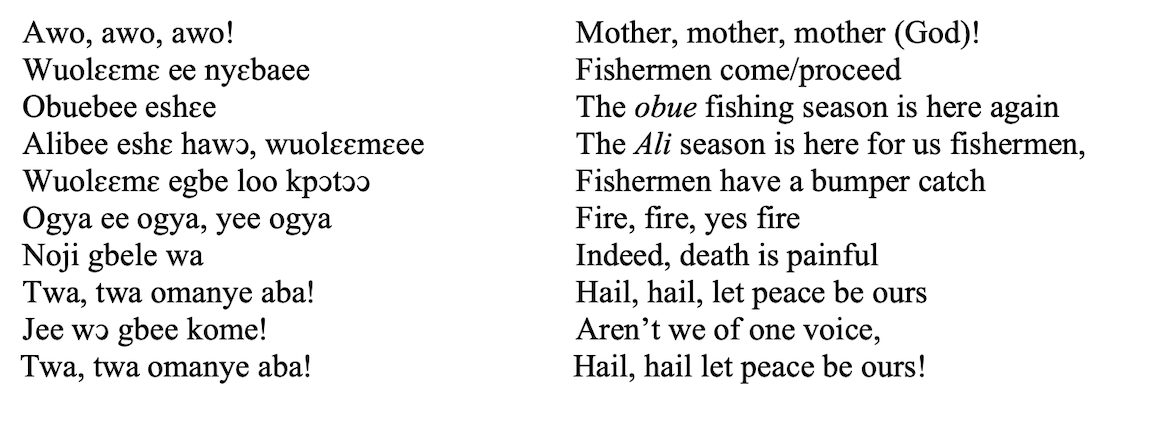
From the foregoing, the question whether the film adaptation should maintain all the original songs has been answered in the negative. Similarly, the question whether the deployment of only six out of fourteen songs can still guarantee the adaptation’s faithfulness to the original story is arguably negative, not necessarily because of the numbers but more importantly the weight of the omitted songs to the story. For example, two of the original songs that Crenstil left out of his adaptation include the overture to the opera whose lyrics and style Acquaye intended to foreground the fishermen/fishing-related theme of the story, as well as hint at other important themes of the opera including the danger at sea. Below are some of the key lines of the overture47:
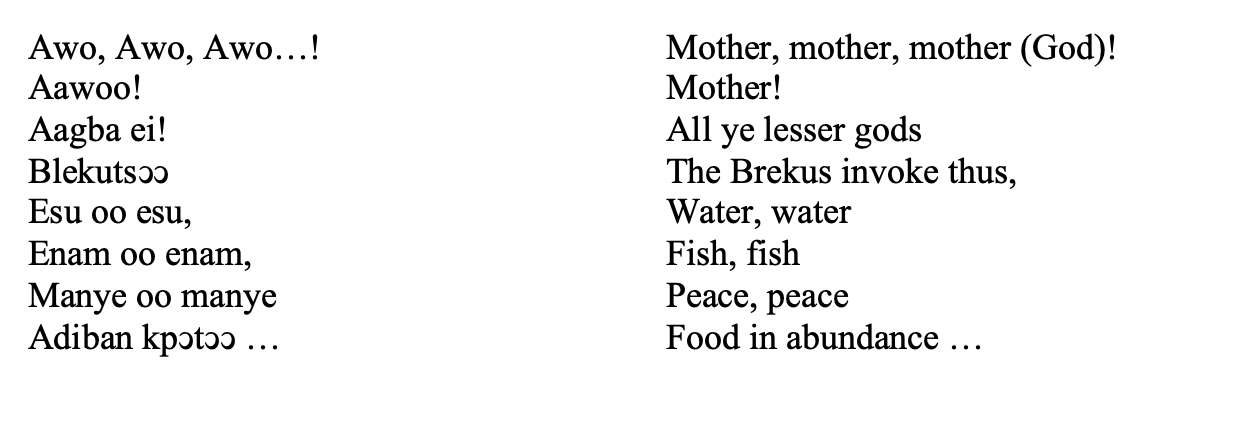
Arguably, Crenstil may have dispensed with the overture because some of the key songs and themes it hints at, like the asafo songs, are performed in full later in the film opera. What betrays his well-intended stance however is the complete omission of the Awo, Awo kple chant from the entire film adaptation. As noted earlier, the chant is the foremost kple ritual prayer among Aquaye’s Ga people performed during all ritual occasions, particularly the kind implied in The Lost Fishermen story that involves indigenous values, deities and taboos. The fact that Acquaye used the chant not just in the opening lines of the overture but on two other occasions in the first scene alone demonstrates its centrality to The Lost Fishermen story. Below is the text in the Ga language48 with the English translation49.
It is therefore my considered opinion that the complete omission of the chant from the film opera undermines its fidelity to the original folk opera as far as the music is concerned. Thus, in the light of the very significant innovations, including the underutilisation of the original songs, how may the “to what extent …” criterion be applied to determine whether The Lost Fishermen film safeguards the original?50 Since adaptation is inherently subject to the vagaries of representation, notions of fidelity on which the success of safeguarding hangs cannot mean exact reproduction but rather in terms of the degree to which the resultant story resembles the referent. My response therefore is that even though some of the original songs have been left out, the adaptation provides a reasonable safeguard for The Lost Fishermen folk opera and, in certain instances as discussed above, enhances the story’s realities and believability even better. Film’s ontological features such as shooting from location, use of special effects and signature tunes more than compensate for the unused songs and allow the story to unfold more naturally. To this, Livingstone argues, in the words of James Harold, that there is “no such thing as ‘global’51 fidelity. No film could be faithful to its source in every respect because adaptations, by their nature, include departures (at a minimum, those necessary to the change of medium) from the source.”52 Thus, even though the adaptation has transformed the original work’s core theatre attributes such as its music, liveness, immediacy and interactivity, the more accessible cinematic version safeguards the endangered art by, increasing interest in and drawing attention to the original work and preserving its story and themes.
Adaptation as Documentation and a Safeguard
One of the foremost reasons for resorting to cinematic adaptation as a safeguard for The Lost Fishermen was its capacity for composite documentation. The argument is that cinematic adaptation for the purpose of safeguarding ought to be conceptualised in terms of composite audio-visual documentation for the ease of accessibility and viewing and for achieving contemporary socio-cultural relevance. Documentation is undeniably a most comprehensive strategy for supporting the viability of musical genres, and it has been the focus of hundreds of applied initiatives to preserve forms of expression for future generations.53 Cinema’s integration of sound with moving pictures offers a relatively superior documentation medium that combines sustainable safeguarding with live entertainment as well as accommodates innovations that enhance its contemporary socio-cultural relevance. The idea of socio-cultural relevance through the cinematic medium is particularly important for courting contemporary audiences who our earlier theatre presentations failed woefully to excite. Additionally, cinema’s inherent capacity to enhance the visual realities of story through on-site shooting and use of special effects adds to that “medium’s expressive scope for building a story without undermining the viewer’s impression of reality.”54 These are the genre-specific factors that enhance the documentary credibility of the screenplay and thus put the safeguarding objective of the project within reach.
The documentation argument ought to be seen also in terms of the human agents involved with preserving the arts — the creative brains and cultural bearers who embody the creative, performative, and transmission skills and values that ensure the survivability of the tradition. This perspective can be inferred from UNESCO’s “Guidelines for the Establishment of National ‘Living Human Treasures’ Systems” within the framework of the Intangible Cultural Heritage (ICH). It states, among other things that, “one of the most effective ways to achieve the sustainable safeguarding of the intangible cultural heritage would be to guarantee that the bearers of that heritage continue to further develop their knowledge and skills and transmit them to younger generations”55 Essentially, this guideline stretches the idea of sustainable safeguarding beyond activities and advocacy and focuses instead on the human resources themselves. In this regard, the likes of Kwame Crenstil whose embodied interest and soft cinematographic skills are at the centre of this project, ought to be seen as guarantors for cultural safeguarding. Such skilled persons function as heritage bearers with the potential to develop their own knowledge and skills further and to transmit same to posterity. In addition to the knowledge, skills and interest they embody, they also safeguard the memories and extraordinary achievements of long departed creatives, like Saka Acquaye, whose creative endeavours have made safeguarding projects like this one necessary.
Conclusion
In this paper, I have explored the audio-visual, documentary, entertainment, and viewer-friendly qualities of cinematic adaptation as a safeguard for Saka Acquaye’s The Lost Fishermen folk opera undertaken by Kwame Crenstil. Apart from the project’s safeguarding intent, it is also the fact that the original work is an operatic art (a music theatre), which integrates music with drama more than the cinematic medium usually permits, that constrains the project’s essence. I argue, therefore, that in adaptation models that are designed for safeguarding purposes, the imperative to manage change and innovation occasioned by the medium change is a necessary technical requirement for the attainment of a reasonable measure of fidelity necessary for retaining the title of the source material. Additionally, the medium change and the representational implications of adaptation, in that it is never an exact reproduction, necessitate an engagement with the fidelity issue and the degree to which it should be present in the resultant work to qualify it as a useful safeguard. Thus, the limited deployment of the original songs in the film opera, while it undermines its fidelity depth to the original, does not invalidate the safeguarding objective. This is because the centrality of signature tunes, spoken dialogue, special effect and shooting on location to the cinematic medium compensate for the unused songs and allow the story to unfold more naturally. Crenstil’s project marks the first time that The Lost Fishermen folk opera’s safety and availability on demand has been put beyond doubt through cinematic documentation and transmission. Hence, the technology-intensive domain of cinema provides a lifeline for salvaging endangered African operatic arts as well as a guarantee for future operatic initiatives to thrive.
References
Abdi, Kaha. “‘A Beauty Full of Healing’: Black Aesthetics as Methodology.” International Journal of Qualitative Methods 23 (2024), https://doi.org/10.1177/16094069241282867.
Acquaye, Saka. “Modern Folk Opera in Ghana.” African Arts 4, no. 2 (1971): 60–63.
Acquaye, Saka. “Folk Opera in Ghana and Nigeria.” Paper presented at the Symposium on African and Afro-American Music, Accra, Ghana, March 1972.
Allen, Ray. “An American Folk Opera? Triangulating Folkness, Blackness, and Americaness in Gershwin and Heyward’s ‘Porgy and Bess.’” Journal of American Folklore 117, no. 465 (2004): 243–61.
Anteh, Emmanuel A. Ga Ŋamↄi, Salutations of the Ga People. Accra: Waterville Publishing House, 1987.
André, Naomi. Black Opera: History, Power, Engagement. Urbana: University of Illinois Press, 2018.
Askew, Kelly. Performing the Nation: Swahili Music and Cultural Politics in Tanzania. Chicago: University of Chicago Press, 2003.
Bame, Kwabena. Profiles in African Traditional Popular Culture: Consensus and Conflict. New York: Clear Type Press Inc., 1974.
Barber, Karin, John Collins, and Alain Ricard. West African Popular Theatre. Bloomington: Indiana University Press, 1997.
Bazin, André. What is Cinema? II. University of California Press, 1971.
Bluestone, George. Novels into Film: The Metamorphosis of Fiction into Cinema. Baltimore:
Johns Hopkins Press, 1957.
Burt, George. The Art of Film Music. Lebanon, NH: University Press of New England, 1994.
Canet, Fernando. “The New Realistic Trend in Contemporary World Cinema: Ramin Bahrani’s Chop Shop as a Case Study.” Acta Universitatis Sapientiae, Film and Media Studies 7 (2013): 153–67.
Cole, Catherine. Ghana’s Concert Party Theatre. Bloomington: Indiana University Press, 2001.
Collins, John. “The Ghanaian Concert Party: African Popular Entertainment at the Crossroads.” PhD diss., State University of New York at Buffalo, 1994.
Duro-Ladipo, Abiodun, and Gboyega Kolawole. “Opera in Nigeria: The Case of Duro Ladipo's ‘O̧ba Kòso.’” Black Music Research Journal 17, no. 1 (1997): 101–29.
Euba, Akin. “Concepts of Neo-African Music as Manifested in Yoruba Folk Opera.” In The African Diaspora: A Musical Perspective, edited by Ingrid T. Monson, 207–38. New York: Garland Publishers, 2004.
Gavua, Kodzo. “Monuments and Negotiations of Power in Ghana.” In The Politics of Heritage in Africa: Economies, Histories and Infrastructures, edited by Derek Peterson, Kodzo Gavua, and Ciraj Rassool, 97–112. Cambridge: Cambridge University Press, 2015.
Gallez, Douglas. “Theories of Film Music.” Cinema Journal 9, no. 2 (1970): 40–47.
Grant, Catherine. “Perspectives of Culture-Bearers on the Vitality, Viability and Value of Traditional Khmer Music Genres in Contemporary Cambodia.” The Asia Pacific Journal of Anthropology 15, no. 1 (2014): 26–46.
Grant, Catherine. “A Case for Greater Interdisciplinary Collaboration in Language and Music Revitalization.” In The Routledge Handbook of Language Revitalization, edited by Leena Huss, Gerald Roche, and Leanne Hinton, 236–44. London: Routledge, 2018.
Grant, Catherine and Chhuon Sarin. “Gauging Music Vitality and Viability: Three Cases from Cambodia.” Yearbook for Traditional Music 48 (2016): 25–47.
Harold, James. “The Value of Fidelity in Adaptation.” The British Journal of Aesthetics 58, no. 1 (2018): 89–100.
Hess, Janet. “Exhibiting Ghana: Display, Documentary, and ‘National’ Art in the Nkrumah Era.” African Studies Review 44, no. 1 (2001): 59–77.
Hutcheon, Linda. A Theory of Adaptation. 2nd ed. New York: Routledge, 2013.
Kalinak, Kathryn. Film Music: A Very Short Introduction. New York: Oxford University Press, 2023.
Klein, Tobias Robert. “The Phantom of the West African Opera. A tour d’horizon.” In
African Theatre 19: Opera & Music Theatre, edited by Christine Matzke, Lena van der Hoven, Christopher Odhiambo, and Hilde Roos, 136–58. Suffolk, UK : James Currey, 2020.
Livingston, Paisley. “On the Appreciation of Cinematic Adaptations.” Projections 4, no. 2 (2010): 104–27.
Mascelli, Joseph. The Five C’s of Cinematography: Motion Picture Filming Techniques Simplified. Hollywood: Cine/Grafic Publications, 1965.
Nii-Dortey, Moses. “Folk Opera and the Cultural Politics of Post-Independence Ghana: Saka Acquaye’s The Lost Fishermen.” In The Politics of Heritage in Africa: Economies, Histories, and Infrastructures, edited by Derek Peterson, Kodzo Gavua, and Ciraj Rassool, 222–33. Cambridge: Cambridge University Press, 2015.
Nii-Dortey, Moses. “Finding the Lost Fishermen: A Study in Recovery and Performance as Preservation.” In Arts Research Africa 2020 Conference Proceedings, edited by Christo Doherty. 67–77. Johannesburg: University of Witwatersrand, 2020, https://hdl.handle.net/10539/29248.
Nkrumah, Kwame. Africa Must Unite. London: Heinemann, 1963.
Nzewi, Meki. “Acquiring Knowledge of the Musical Arts in Traditional Society.” In Musical Arts in Africa: Theory, Practice and Education, edited by Anri Herbst, Meki Nzewi, and Kofi Agawu, 13–37. Pretoria: Unisa Press, 2003.
Pendergast, Roy. Film Music: A Neglected Art: A Critical Study of Music in Films. New York: W.W. Norton, 1992.
Rathbone, Richard. Nkrumah & the Chiefs: The Politics of Chieftaincy in Ghana, 1951–60. Athens: Ohio State University Press, 2000.
Saah, Kofi, and Kofi Baku. “‘Do not rob us of ourselves’: Language and Nationalism in Colonial Ghana.” In Identity Meets Nationality: Voices from the Humanities, edited by Helen Lauer, Nana Aba Appiah Amfo, and Jemima Asabea Anderson, 74–99. Accra: Sub-Saharan Publishers, 2011.
Saidi, Mpawenimana and Oladimeji Talibu. “Hutu-Tutsi Conflict in Burundi: A Critical Exploration of Factors.” International Journal of Humanities and Social Studies 3, no. 6 (2015): 298–304.
Stam, Robert. “Beyond Fidelity: The Dialogics of Adaptation.” In Film Adaptation, edited by James Naremore, 54–76. New Brunswick, NJ: Rutgers University Press, 2000.
Soyinka, Wole. “African Traditions at Home in the Opera House.” New York Times, 25 April 1999, 21.
Ukadike, Nwachukwu. Black African Cinema. Berkeley: University of California Press, 1994.
UNESCO. Guidelines for the Establishment of National Living Human Treasures Systems. Paris: UNESCO, 2002, https://ich.unesco.org/doc/src/00031-EN.pdf.
UNESCO. Text of the Convention of the Safeguarding of the Intangible Cultural Heritage. Paris: UNESCO, 2003. https://ich.unesco.org/en/convention.
Notes
1 In 1977, The Lost Fishermen was part of Ghana’s selected works for the Second Black Festival of Arts and Culture (FESTAC) in Lagos, Nigeria. In 1986, it was staged at the Shaw Theatre, London, to commemorate ten years of the Black Theatre Workshop by twelve leading Manhattan Brothers led by the late South African actor, Nathan Mydledle, and produced by the Gambian-born British actor, Louis Mahoney.
2 Saka Acquaye died two weeks after he received the UNESCO Living Human Treasure award on his sick bed.
3 Kwame Crestil is a professional film producer.
4 For more see Nwachukwu Ukadike, Black African Cinema (Berkeley: University of California Press, 1994).
5 For more see Karin Barber, John Collins, and Alain Ricard, West African Popular Theatre (Bloomington: Indiana University Press, 1997); and Abiodun Duro-Ladipo and Gboyega Kolawole, “Opera in Nigeria: The Case of Duro Ladipo’s ‘Oba Kòso,’” Black Music Research Journal 17, no. 1 (1997): 101–29.
6 For more on film adaptations see George Bluestone, Novels into Films (Baltimore, MD: Johns Hopkins Press, 1957); and Robert Stam, “Beyond Fidelity: The Dialogics of Adaptation,” in Film Adaptation, ed. James Naremore (New Brunswick, NJ: Rutgers University Press, 2000), 54–76.
7 For more on Ghanaian operatic traditions see Kwabena Bame, Profiles in African Traditional Popular Culture: Consensus and Conflict (New York: Clear Type Press, Inc., 1974); Barber, West African Popular Theatre; and Catherine Cole, Ghana’s Concert Party Theatre (Bloomington: Indiana University Press, 2001).
8 Catherine Grant, “Perspectives of Culture-Bearers on the Vitality, Viability and Value of Traditional Khmer Music Genres in Contemporary Cambodia,” The Asia Pacific Journal of Anthropology 15, no. 1 (2014): 26–46. See also John Collins, “The Ghanaian Concert Party: African Popular Entertainment at the Crossroads,” (PhD diss., State University of New York at Buffalo, 1994); and Tobias Robert Klein, “The Phantom of the West African Opera. A tour d’horizon,” in African Theatre 19: Opera & Music Theatre, eds. Christine Matzke, Lena van der Hoven, Christopher Odhiambo, and Hilde Roos, 136–58 (Woodbridge, UK: Boydell & Brewer, 2020).
9 I have been working on The Lost Fishermen folk opera with the prior permission of the Acquaye family for academic purposes since 2002. See Moses Nii-Dortey, “Finding the Lost Fishermen: A Study in Recovery and Performance as Preservation,” in Arts Research Africa 2020 Conference Proceedings, ed. Christo Doherty (Johannesburg: University of Witwatersrand, 2020), 66–77, https://hdl.handle.net/10539/29248. For more on efforts to revitalize performing arts traditions see Grant, “Perspectives of Culture-Bearers”; Catherine Grant and Chhuon Sarin, “Gauging Music Vitality and Viability: Three Cases from Cambodia,” Yearbook for Traditional Music 48 (2016): 25–47; and Moses Nii-Dortey, “Folk Opera and the Cultural Politics of Post-Independence Ghana: Saka Acquaye’s The Lost Fisherman,” in The Politics of Heritage in Africa: Economics, Histories, and Infrastructures, eds. Derek Peterson, Kodzo Gavua, and Ciraj Rassool (Cambridge: Cambridge University Press, 2015), 222–33.
10 Saka Acquaye, “Folk Opera in Ghana and Nigeria,” (Conference paper, Symposium on African and Afro-American Music, Institute of African Studies, University of Ghana, Accra, Ghana, 6–11 March 1972), 3.
11 See Nii-Dortey, “Folk Opera,” 2015.
12 “…the most accessible…” Wole Soyinka, “African Traditions at Home in the Opera House,” New York Times, 25 April 1999, 21. See also Ray Allen, “An American Folk Opera? Triangulating Folkness, Blackness, and Americaness in Gershwin and Heyward’s ‘Porgy and Bess,’” Journal of American Folklore 177, no. 465 (2004): 243–61; Naomi André, Black Opera: History, Power, Engagement (Urbana: University of Illinois Press, 2018); Akin Euba, “Concepts of Neo-African Music as Manifested in Yoruba Folk Opera,” in The African Diaspora: A Musical Perspective, ed. Ingrid T. Monson (New York: Garland Publishers, 2004), 207–38; and Meki Nzewi, “Acquiring Knowledge of the Musical Arts in Traditional Society,” in Musical Arts in Africa: Theory, Practice and Education, eds. Anri Herbst, Meki Nzewi, and Kofi Agawu (Pretoria: Unisa Press, 2003), 13–27.
13 Acquaye, “Folk Opera in Ghana and Nigeria,” 3.
14 For more on this history see Janet Hess, “Exhibiting Ghana: Display, Documentary, and ‘National Art’ in the Nkrumah Era,” African Studies Review 44, no. 1 (2001): 59–77; and Richard Rathbone, Nkrumah & the Chiefs: The Politics of Chieftaincy in Ghana 1951–60 (Athens: University of Ohio Press, 2000).
15 For Tanzania see Askew, Performing the Nation; for Nigeria see Oxford Encyclopaedia of African History, “The Biafran War,” by Ogechukwu E. Williams, 27 February 2024, https://doi-org.libproxy.lib.unc.edu/10.1093/acrefore/9780190277734.013.272; and for Rwanda see Mpawenimana Saidi and Oladimeji Talibu, “Hutu-Tutsi Conflict in Burundi: A Critical Exploration of Factors,” International Journal of Humanities and Social Studies 3, no. 6 (2015): 298–304.
16 See Acquaye, “Folk Opera in Ghana and Nigeria” and Kwame Nkrumah, Africa Must Unite (London: Heinemann, 1963).
17 Kofi Saah and Kofi Baku, “‘Do Not Rob Us of Ourselves’: Language and Nationalism in Colonial Ghana,” in Identity Meets Nationality: Voices from the Humanities, eds. Helen Lauer, Nana Aba Appiah Amfo, and Jemima Asabea Anderson (Accra: Sub-Saharan Publishers, 2011), 74–99.
18 Readers may view a section of The Lost Fishermen (2007) at https://youtu.be/btovM8uvXvg, Directed by Addoquaye Moffat, Music by Moses Nii-Dortey, and Dance by George Jikunu.
19 See Moses Nii-Dortey, “Finding the Lost Fishermen.”
20 See Gavua, “Monuments and Negotiations of Power in Ghana” and Nii-Dortey, “Folk Opera.”
21 On adaptations see Linda Hutcheon, A Theory of Adaptation, 2nd ed. (New York: Routledge, 2006); Paisley Livingston, “On Appreciation of Cinematic Adaptations,” Projections 4, no. 2 (2010): 104–27; and Stam, “Beyond Fidelity.”
37 For more on film production techniques see Joseph Mascelli, The Five C’s of Cinematography: Motion Picture Filming Techniques Simplified (Hollywood: Cine/Grafic Publications, 1965).
38 For more on realism in film see Canet, “The New Realistic Trend in Contemporary World Cinema,” Acta Universitatis Sapientiae, Film and Media Studies 7 (2013): 153–67; and Harold, “The Value of Fidelity in Adaptation,” 92.
39 See Andre Bazin, What is Cinema? II. University of California Press, 26
40 Saka Acquaye, “Modern Folk Opera in Ghana,” African Arts 4, no. 2 (1971): 62.
41 See Kaha Abdi, “‘A Beauty Full of Healing’: Black Aesthetics as Methodology,” International Journal of Qualitative Methods 23 (2024), https://doi.org/10.1177/16094069241282867; and Soyinka “West African Traditions at Home.”
42 Nii-Dortey, “Folk Opera.”
43Asafo songs are warrior (defiant) chants performed by asafo brigades originally of the Fante ethic group. In more recent years however, many more ethnic groups in southern Ghana, including Saka Acquaye’s native Ga, have and continue to maintain asafo groups and their trademark chants.
44 Kathryn Kalinak, Film Music: A Very Short Introduction (New York: Oxford University Press, 2023), xix.
45 For more on film music see George Burt, The Art of Film Music (Lebanon, NH: University Press of New England, 1994); Kalinak, Film Music; and Roy M. Pendergast, Film Music: A Neglected Art: A Critical Study of Music in Films (New York: W.W. Norton, 1992).
46 Douglas, Gallez, “Theories of Film Music,” Cinema Journal 9, no. 2 (1970): 40–47.
47Obue and Ali represent the two major and minor fishing seasons of the Ga ritual year.
48The Blekus are Acquaye’s native Ga ethnic group’s western neighbours with whom they share many cultural similarities. It is therefore no wonder the Blekus are mentioned in such an important Ga prayer chant.
49Emmanuel A. Anteh, Ga Ŋamↄi, Salutations of the Ga People (Accra: Waterville Publishing House, 1987), 48–49.
50 Harold, “The Value of Fidelity in Adaptation”, 92.
51 Harold, “The Value of Fidelity in Adaptation,” 92.
52 Harold, “The Value of Fidelity in Adaptation,” 92.
53 See Grant, “A Case for Greater Interdisciplinary Collaboration” and UNESCO, Text of the Convention for the Safeguarding of the Intangible Cultural Heritage (Paris: UNESCO, 2003).
54 Canet, “The New Realistic Trend in Contemporary World Cinema,” 153.
55 UNESCO, Guidelines for the Establishment of National Living Human Treasures Systems (Paris, UNESCO, 2002), 2, https://ich.unesco.org/doc/src/00031-EN.pdf.
About the author
Moses Nii-Dortey, (PhD Ethnomusicology and African Studies) is a Snr. Lecturer/Research Fellow, and the Coordinator of the Music & Dance Section at the Institute of African Studies, University of Ghana, Legon. He was a recipient of the African Presidential Fellowship, University of Michigan, Ann Arbor (2009), and AHP Fellow with residency at the University of Dar es Salaam, Tanzania, (2011-2012). Nii-Dortey has published on Arts Research in Africa, folk opera development in Ghana, traditional festivals as integrated performances, the Ghana National Symphony Orchestra (GNSO), and challenges of pre-tertiary Music Education in Ghana, among others. In the last 20 years, Nii-Dortey has also been involved in applied ethnomusicological initiatives to safeguard Ghana’s dying folk operatic tradition pioneered by Saka Acquaye in the 1960s, and the effort has produced two staged performances of ‘The Lost Fishermen’ folk opera in 2007 and 2011, and a short film Adaptation of the same folk opera in 2023, directed by Kwame Crenstil, a master’s student at the Institute of African Studies, University of Ghana, Legon.
This work is licensed under Creative Commons Attribution 4.0 International.